Monday, 3 January 2011

Warm Salad of Stornoway Black Pudding, Stilton, Figs & Rocket


I find it incredibly difficult doing salads without any meat. I'll whack some into a perfectly good salad at times, and lots of it, as protest against all things non non-vegetarian. That wasn't the case this time round though. The centre piece of this one was the best black pudding in the land. Or so Stornoway black pudding is believed to be. The only other thing I could think of doing, at the time, with the black pudding I bought from Borough Market was to have it with a full English, and that seemed a little inappropriate. And I don't think Braveheart would have approved. So a warm salad it was going to be. If an ingredient has a reputation of being tops then some finesse is warranted.

I have seen some very unpleasant faces being made at the mention of black pudding. Almost as unpleasant as the thought of eating cooked pigs blood might be to the owners of those faces. I for one am a huge fan. I got introduced to it by a friend whilst I was living in Edinburgh and having lived there for almost half a decade I love the bloody thing! The texture and the spicy aroma is to die for. And I am sure Mr. Porky would have agreed if he was around to have a wee bite. The other thing black pudding has going for itself is that it ticks the 'waste not want not' box.

To the salad then. Not much to do. Decided to base the salad on some rocket. Thought the pepperiness  would work well with the sweetness of the figs and the salty richness of the unpasteurised Stilton. And it did. Figs and blue cheese is a time tested combination and the availability of some superb figs at the market were the inspiration. Must add here, the figs were a friend's idea, who was with me at the market too. A good cook and the daughter of a great cook.

Piled some rocket on the plate. Drizzled it with some extra virgin olive oil. Laid on the figs and crumbled onto everything the Stilton and fried Stornoway black pudding. And Bob's your uncle.

Monday, 20 December 2010

Borough Market, London

Back in London for bit, and it's good to be back. What really excites me about this city is that there is so much to do. There are always new aspects of the city's life to explore. While I was here during the summer, the Marylebone Farmers' Market was a weekend regular. It was just round the corner from where I lived. Borough Market however, I never got around to going to. I might have missed Borough Market during the bountiful summer but as far as food's concerned there really isn't a bad season. If anything, winter here is a time to indulge and to get festively plump.

Borough Market, Borough, London. 
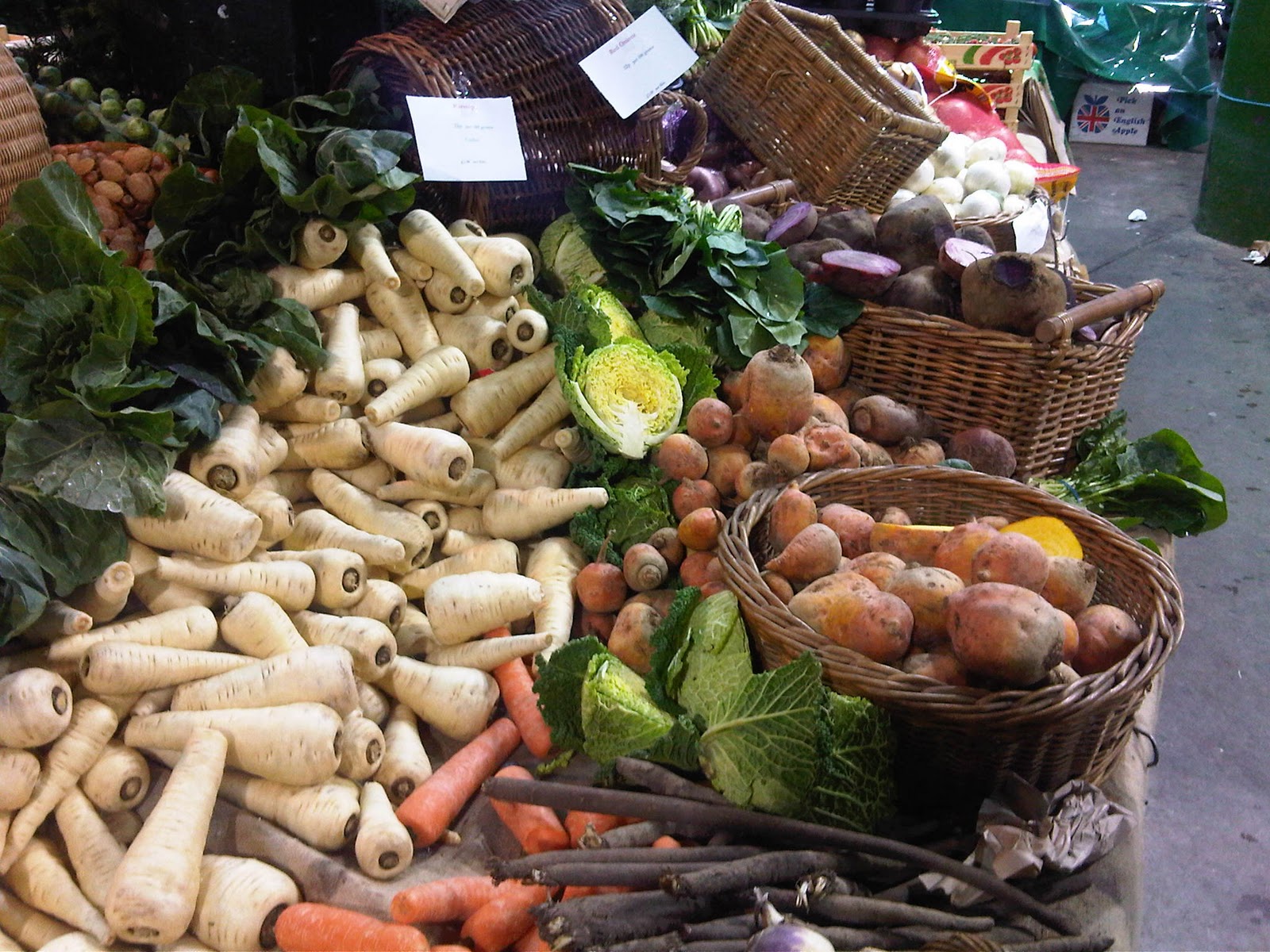
The market itself is decked up for the occasion. The fruit and vegetable stalls were to the brim with fantastic winter harvest. Turnips, parsnips, beet root and savoy cabbage. Dare to think beyond soups and there are unlimited possibilities. But I have to admit, a nice, hearty, chunky, winter soup would be on the top of my agenda. Maybe because of the snow and the sub-zero temperature.

Winter veg
There was plenty of cheese on offer. From the continent and from nearer by. A nice strong blue I think would be the flavour of the season. But then I am partial to cheese that you can taste in your nose. What was great was that a lot of the local cheeses were unpasteurised, making them creamier than their more shelf-friendly cousins. The cold however, makes the cheese a little stiff. You need to bring it up to room temperature to get the creaminess back. I however, was more than happy walking around munching on a wedge of unpasteurised Stilton, called Stichelton. I first had a Stichelton at St. John Restaurant. That one was from Neal's Yard.

The Welsh Caerphilly
As for something I hadn't had before - the Caerphilly. A hard, crumbly, cow's, white cheese from Wales. A little nutty I thought, but quite similar to a mild Cheddar. Would go well along side some apple or on Welsh Rarebit. Rarebit is traditionally made with Cheddar.

The Italian connection
There was a sizable Italian section serving up not just the Parmiggiano Reggiano and Mozzarella, but also some less known cheeses, a great selection of cold meats, which the Italians really know how to do, and even some sandwiches to go. 

Fish is a year-round favourite at most farmers' markets. I finally got my first taste of welks, essentially Sea Snails. Cooked, and sprinkled with some vinegar and salt. Real meaty critters. Nice firm texture with good bite. Reminded me of some raw Limpets I ate while fishing near Edinburgh. Good times.

The cold slab at Furness Fish and Game
And there was an Oyster stall, which I couldn't keep away from. 

Richard Haward's Oysters

Mid-season Oysters
Native Oyster season lasts from September to April and Pacific Oysters are available all year round. There was a little banter with the man behind the stall as to how Oysters should be eaten. While the lemon, Tabasco, and red-wine vinegar and shallots mignonette are all good, I quite like them just the way they are. Without messing about with the natural ozoney saltiness. And if you are just going to get them down you as quickly as you possibly can, then don't bother with oysters at all. A couple of bites are necessary to get your money's worth (and the full flavour, of course). I like fondling them with my molars a bit more. The two shucked oysters on the left are Colchester Natives and the ones on the right are Rock Oysters. Rock oysters were brought in from the Pacific but have now made their way into the wild in this country. The Grey Squirrel of Oysters. 

Pork pies
No farmers' market is complete without a butcher, and from what I saw, Borough Market has four very fine ones, including a branch of the Ginger Pig. Two of them not only have meat to go, but also cooked on the spot hot meals. Roast sandwiches to stews to curries. Not to forget all the traders selling meat products. From sausages, cured and preserved meats, to pies and pasties. 

A pig, many ways

Prepared lamb


Farmed geese and pheasants at Furness

Mallards and partridges
With Christmas round the corner the displays were very well stocked with roasting joints and birds. There was a fantastic selection of game, farmed and wild. Pheasants, hare, rabbit, pigeon, duck, venison, wild boar, the works. I spent a lot of time just wandering around the displays admiring the craftsmanship of the butchers and the quality of the meat.

Mr. Porky
Mr. Porky's smile is infectious. Made me chuckle even. Just as my eye caught sight of the pig's head on Furness' counter top, the thought of Fergus Henderson's Warm Pig's Head made me salivate. It wasn't on the menu at his Smithfield restaurant, nor on the menu at Spitalfield. A Warm Pig's Head remains a supper to be had.

A bowl of fish soup, some welks, a wedge of Stilton, some oysters, a Malaysian chicken curry with jasmine rice and a glass of mulled wine later thought turned to dinner. I wasn't about to give up the chance of cooking with some of the fantastic ingredients at the market. 

Tuesday, 7 December 2010

Coca-cola chicken

Yes, you heard right! A friend from the Guangdong province cooked this one evening and completely took me by surprise. Guangdong is where Cantonese food comes from, for those of you food geographers. And then come to think of it, coca-cola has got to be the perfect ingredient to get a sweet, sticky base. And balance that sweet with the salty of soy sauce and you are on to something!

This recipe works with any part of the chicken, and is superb with wings. Skin left on if you are not fussed about your weight. Wouldn't use breast meat myself, but do as you please.

For the sauce/syrup:
  • 3 tablespoons of coca-cola to one of soy sauce. I use light, but dark will do too.
  • sliced ginger
  • sliced garlic
  • sliced spring onions
  • sliced chillies
I added some dried red chillies for a deeper, smokier heat. And it gives me great pleasure to report that that was a winner.


Let the aromatics infuse and in the mean time fry off the chicken wings till cooked. I used olive oil. But I think that a little bit of added sesame oil would go down a treat adding that unmistakable woody, oriental fragrance.


Once the wings are cooked put in the syrup and stir occasionally till all the liquid has evaporated and the chicken is coated in a sticky goo. The goo is bloody awesome! Next time I'd leave it a little runny to eat with sticky rice. You just know it's going to be good. I served it with some home-grown, wilted, Pok Choi.

Monday, 29 November 2010

Easy as pie?

I have always admired people who can bake. It isn't like cooking where you can just whack stuff together. Baking drills a certain discipline into you, teaches a cook how to follow orders when the urge is to do otherwise. No wonder some of the best chefs in the world train as pastry chefs at some point in their career.

Now, I knew baking wasn't easy, yet so easily forgot. A disastrous attempt at making puff pastry sent me crashing down to earth this evening. I knew the ingredients I had weren't perfect. To begin with, I only had plain flour as opposed to strong flour, and I was a little short on butter. Though I did not expect fireworks to begin with, I was horrified at how different the pastry was to anything remotely like puff pastry. It sure was nothing like how I had imagined it.

Not saying that it's time to put away the butcher's knife and bring out the oven mitts, but most certainly time to give the cake tins a little attention.

Thursday, 25 November 2010

Indigo, Colaba, Mumbai.

The much talked about Indigo in Colaba, Mumbai. World class cuisine with Indian notes to some, to others, a failed attempt to bring fine dining to the city. I have wanted to go to the place for sometime now, since I saw Rahul, also a Dosco, on a television interview a few years ago. So this time around, while I was in Mumbai, a snoop was in order.

The property is beautiful, nestled in a by-lane in old Mumbai. A bungalow surrounded by greenery and old-world charm. you enter into the contemporary, dimly lit lounge, with a bar running its length. The two dining rooms on the ground floor were skipped in favour of the terrace. A nice terrace, ambient and cooled by the winter breeze, and the large fans that were only about a couple of metres from the table.

The menu is extensive, but then a clientele as diverse as the one in this city is not easy to please. It did take me a couple of whiskies to take it all in. They were running a special 'Best of the Last 10 Years' menu, and there I found myself suddenly scrutinizing everything even more intently. Best you say huh? Well, let's see how good your best is then!

Ravioli of Curried Pumpkin with Sage Butter and Pinenuts
You eat with your eyes even before your mouth gets involved, and the presentation could have been better. I prefer square ravioli for some reason, and if it's going to be round then make them bigger. Five was a crowd. But a good sized starter. I give Indigo the benefit of the doubt and let's say that even if the pasta was made fresh on the day, the edges were a little too thick, making them a little dry.

As for the flavours, the sweetness of the curried pumpkin worked beautifully with the salty Parmesan and the sweet and savoury Sage Butter. A little too salty though. A tad bit less cheese would have done the trick. But a good contrast, almost very well balanced.

Pan-roasted Duck with Coriander & Orange Glaze with Baked Turnip Puree and Snowpeas
How well a duck breast is cooked says a lot about a kitchen in my mind. And when the waiter said to me that the chef highly recommends that the duck be ordered medium rare I though to myself - this is going to be good. They know what they are talking about. And because I like my meat to still be bleeding on the plate, I ordered it as rare as the chef wanted to cook it. 

And the moment I saw the plate of food my heart sank. Not even a hue of pink. More brown. I was convinced that they had used frozen duck breast. I can't see how a fresh breast could have been murdered like this. They assured me that their duck was fresh. Since the meal, a few people who I trust with food in the city have told me otherwise.  

Put knife to meat and I lost the will to live. Soggy skin. Rubbery. This really does makes me think that the breast came out of a vacuum sealed packet. And even if it was fresh it was just so hopelessly cooked. The flavours worked though, but then citrus and sweet take to duck very well and it's a time-tested combination. Like pork and apple or lamb and mint or beef and mustard. So nothing worth praise here. The coriander in the glaze is worth a mention though. The woody punch of the seeds worked well with the sweetness of the glaze, and the turnip puree.

The place has a long way to go before becoming a fine dining destination in my mind. The insult to injury was the waiter's body odor as he reached across the table to pick up my starter plate. Now, the humid weather makes you sweat, but when you are paying through your nose for a meal this is unacceptable. This glitch aside, Indigo may be one of the better places around here, in terms of the food and the dining experience, but it most certainly is rough  around the edges. Maybe they need to rethink the expectations they set along with working on the food and service. Until that happens, over-rated I'd say!

Tuesday, 16 November 2010

Deep fried goats' brains with Green Sauce

The first time I ate brains I wasn't too impressed. I don't think they really taste of much on their own. A little like marrow. Fatty but not as concentrated with flavour. The texture is, well, exactly how you'd imagine it. But I'd try anything twice, and besides I've never cooked them myself. This recipe is from Fergus Henderson's Nose to Tail Eating.


The first thing about brains, I am surprised at how expensive they are. A 100 rupees for 3? Second, they have a smell. A smell even I am not too keen on. You need to rinse them in cold running water to get rid of small pieces of bone and other stuff that does not belong.


In a stock pot simmer for 15 minutes
  • 1 onion, peeled and quartered.
  • 1 carrot
  • bay leaf
  • celery stalk. I used the upper stalk and leaves as the celery cost me an absolute bomb and I didn't have the heart to let anything go to waste. The leaves impart an intense aroma. Very pleasant.
  • a few pepper corns
  • and about 6 cloves of garlic. Bruised
  • You could add in any other fresh herbs. I recommend leaving the herbs whole otherwise they will stick to the brains and the brains will need picking.
Once the stock has simmered for 15 minutes put in the brains and cook gently for 6 minutes. I am not normally this anal about time, but as far as textures are concerned, mine was pretty perfect, so stick to Dr. Henderson's 6. The poaches takes away the pungent smell of the brains, and of course, pre-cooks them before the frying.

Fish out the poached brains and leave to cool. While the brains cool prepare these 3 bowls:
  1. Plain flour. Seasoned with salt and pepper
  2. 2 eggs whisked with 100mls of milk
  3. breadcrumbs
Once cold separate the lobes of the brains. Introduce them to the 3 bowls in the same order as above, coating well, and then into a sauce pan of hot vegetable oil. The frying is very quick. Pull them out golden.


I had mine with Green sauce, another Henderson creation. It is finely chopped parsley, dill, mint, garlic, capers, crushed pepper and extra virgin olive oil. Wish I had some anchovies. Chopped anchovies was, I think, the ingredient that seals the deal on this sauce, and also the only ingredient I could not get my hands on. The anchovies were missed.

My opinion of brains hasn't changed much. I'd happily eat them, but I'd much rather cook them.

Monday, 15 November 2010

Gamda nu khavaanu

I seldom hesitate in telling people of the non-Indian credentials of the Chicken Tikka Masala or the Balti. Indian food is more than that. It's about marrying countless spices in accordance to timeless recipes, about impart flavours through patience and pain. It's about serving up rich portions of food in generous proportions. Food fit for kings. Or is it?

These ideas of extravagance are most certainly not false. But, there is another India. If Indian food is what most Indians eat on a daily basis then this is it.

I have been working on 'The Land' for the past few days, coming home in the afternoon for lunch, and to get out of the blistering mid-day sun. Its been a while since I ate there, with the care-taker and his wife, and some good gamda nu khavaanu (village food in Gujarati) was long over due. Cooking in rural India is no easy feat. The wood has to be foraged and prepared, the fire tended to with great care and, in the case of dinner, the setting sun to race.

Sunita cooking the potatoes and eggplant
The village spread
The food can best be described as functional. Wheat is not on the menu of most rural households. Coarse grain such as corn, jowar (sorghum) and bajra (pearl millet) are the order of the day and the bread is unlike the rotis or the naans served up in restaurants. The 'roti' (called rotla in Gujarati when made from these coarse grain) are heafty, dense and on most occasions eaten cold. They taste great hot with some melted butter on the top but labourers working in the farms do not have that luxury, and nor did I.

The bajra was cultivated on The Land itself and the veg was picked from neighbouring farms. Debts are settled in kind. The eggplant was paid for in grass for the farmers buffalo. I think the potatoes were too. It's all done on good faith. That afternoon only a handful of ingredients went into everything. Garlic, chilli, turmeric, and salt and lots of oil. Without non-stick cookware the copious amounts of oil is a necessity. The oil also helps prevent the food  drying up as left overs are consumed at the next meal and are stored in a cool place without refrigeration.

This is great food. Hardy and whole. Only one complaint though. No meat?